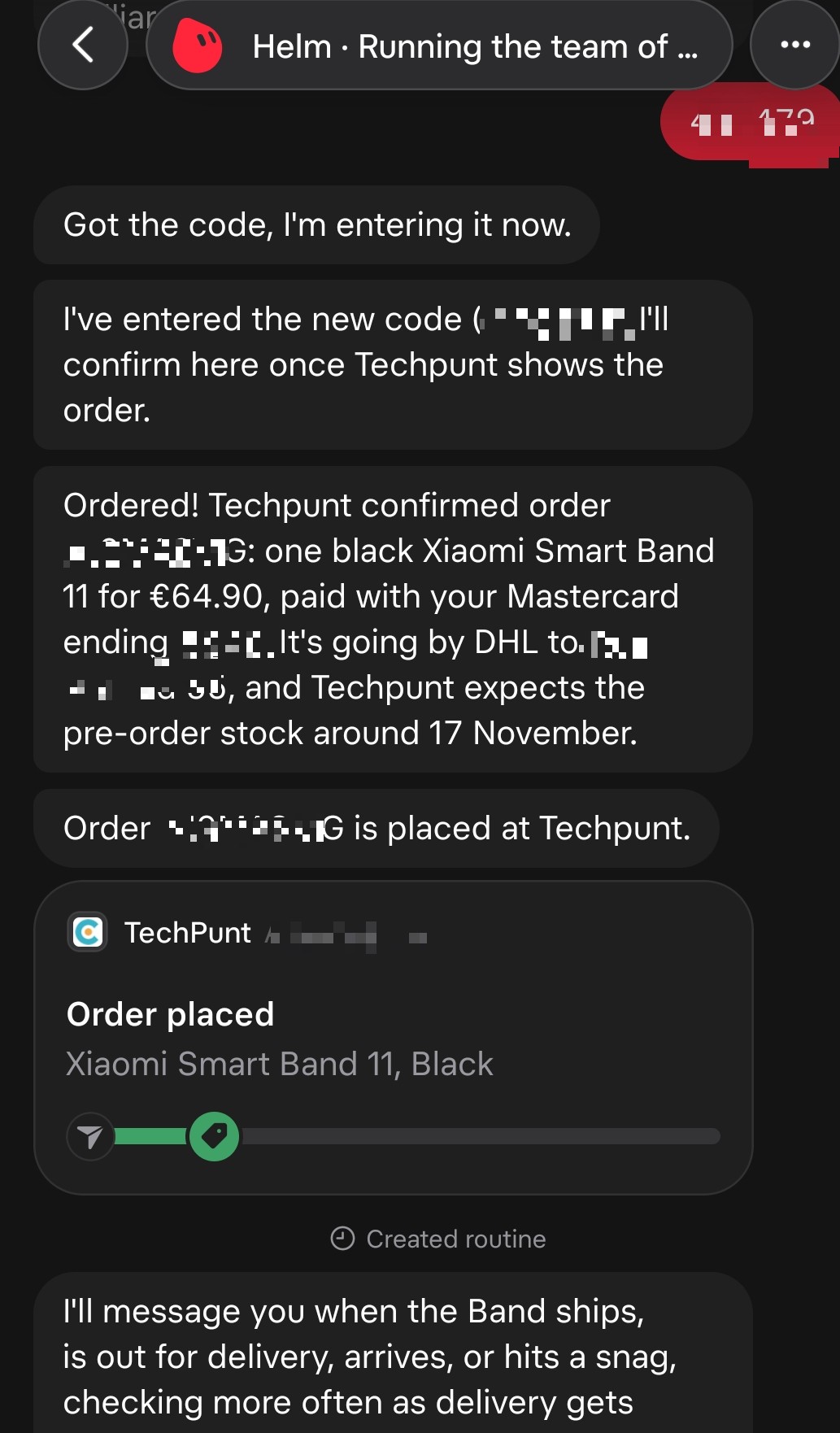
My team of Grok bots just handled a product order I had asked them to watch. They notified me when it became available, waited for my go-ahead, completed the entire purchase flow, and then set a scheduled task to monitor the shipping tracking. I barely touched anything after the initial instruction.
Does that mean websites are finished if most of the clicks and form-filling are done by agents instead of me? No. It means the opposite.
The first wave of modern AI was the giant models that scraped the internet and baked the knowledge directly into their weights. That is why we had those sharp cut-off dates - the model’s world stopped on a specific day. Useful, impressive, but fundamentally a compressed encyclopedia that could not see what happened after training.
The next step was smarter models that could call tools: search, browse, run code, query APIs, check the live web. They still carried a lot of embedded knowledge, but they could reach outside when needed.
What comes after is leaner, sharper models that deliberately carry less of the internet inside them. They are better at reasoning, planning, and using the tools around them. Andrej Karpathy has been pointing in this direction for a while: a compact “cognitive core” focused on the algorithms of thought, not the memorization of every fact. Most of the capacity in today’s large models is spent storing static knowledge that could live outside. A smaller model that knows how to look things up, verify, and act can be faster, cheaper, and more practical - especially at the edge.
The race for LLM "cognitive core" - a few billion param model that maximally sacrifices encyclopedic knowledge for capability. It lives always-on and by default on every computer as the kernel of LLM personal computing.
Its features are slowly crystalizing:- Natively multimodal text/vision/audio at both input and output.
- Matryoshka-style architecture allowing a dial of capability up and down at test time.
- Reasoning, also with a dial. (system 2)
- Aggressively tool-using.
- On-device finetuning LoRA slots for test-time training, personalization and customization.
- Delegates and double checks just the right parts with the oracles in the cloud if internet is available.It doesn't know that William the Conqueror's reign ended in September 9 1087, but it vaguely recognizes the name and can look up the date. It can't recite the SHA-256 of empty string as e3b0c442..., but it can calculate it quickly should you really want it.
What LLM personal computing lacks in broad world knowledge and top tier problem-solving capability it will make up in super low interaction latency (especially as multimodal matures), direct / private access to data and state, offline continuity, sovereignty ("not your weights not your brain"). i.e. many of the same reasons we like, use and buy personal computers instead of having thin clients access a cloud via remote desktop or so.
— Andrej Karpathy (@karpathy) June 27, 2025
This is how I see the future. Maybe one day we get Neuralink-style interfaces and a phone that is little more than a line to your agent. Until then, the practical reality is agents and humans working side by side. The agents handle the repetitive, high-speed, tool-heavy work. Humans keep the ownership, set the direction, and step in when judgment or preference is required.
Elon Musk: “I am not working on a phone. I can tell you where I think things will go, which is that we’re not going to have a phone in the traditional sense. What we’ll call a phone will really be an edge node for AI inference with some radios to connect. Essentially, you’ll have AI on the server side communicating with AI on your device—formerly known as a phone—and generating real-time video of anything you could possibly want. There won’t be operating systems or apps in the future; it’ll just be a device that’s there for the screen and audio, and to put as much AI on the device as possible.”
(via Joe Rogan Experience Podcast)
— Sawyer Merritt (@SawyerMerritt) October 31, 2025
This is the same pattern Tesla follows with Full Self-Driving. The car does not invent a new environment; it learns to operate efficiently inside the one already designed for humans (roads, signs, other vehicles). Small, efficient AI models will do the same with the digital environment already designed for humans: websites, forms, APIs, emails, calendars.
In a way, this is returning to how the internet was originally designed - a decentralized place made of many independent spaces rather than a few giant centralized models holding everything. The knowledge and the action live where they belong: on the sites, in the APIs, in the tools, and in the small reasoning cores that know how to use them.
The turning point is when those models are small and fast enough to run locally - even on something like an ESP32-S3, keeping only the tiny core in fast memory while sampling the rest from flash. That is the direction: efficient enough for the edge, powerful enough because they lean on the surrounding environment instead of trying to contain it.
explainer video of how a 28.9M LLM runs on an $8 esp32-s3 fully on-chip, for now it just writes text to screen wired to the chip at ~9 tok/s.
but to generate text you read the whole model every token, and the memory big enough to hold it is slow.
in 2024 Dave Bennett loaded a 260k model into psram and got 19 tok/s. that works because the model is tiny, ~1MB, so reading all of it every token is cheap.
but that does not scale. make the model bigger and every token has to read more bytes from that memory, so it slows down fast. and 14.9MB won't even fit in psram anyway.but google give the path to avoid full model read.
you don't need to read the whole thing. most of the params sit in an embedding table the model reads from.
so you leave that 25M row table in slow flash and pull only the few rows each token needs, about 450 bytes.
only the small core stay in fast memory and head in psram. the big model costs almost nothing to run because you never load most of it, it just sits in flash and gets sampled a bit at a time.that idea is @Google 's per-layer embeddings, from gemma. here it runs on a microcontroller's memory instead of big brothers.
plus @karpathy llama2.c give direction how to train tiny language model and run it in plain C
this whole thing grew out of that.it's trained on tinystories so it writes simple little stories and nothing more, yes.
it won't answer questions or know facts, that's the tiny core, the memory trick doesn't fix that.
the point was find and fit biggest LLM on ESP32— Slava S. (@slvDev) July 24, 2026
For publishers and website owners this is another adaptation cycle, not an extinction event. We already lived through “mobile first.” Luke Wroblewski popularized the idea around 2009–2011: design for the constrained mobile screen first, then expand. Sites did not disappear; they got cleaner, faster, and more focused. Search engines did not kill the web; they forced better structure. AI agents will push the same kind of change.
Websites will stay as dedicated spaces owned by humans. What will change is how easily agents can interact with them. We are currently in the awkward middle: we still mostly ask agents to do things the way a human would click through a site. The sites that adapt first will be the ones that make the agent's job cheap and reliable:
- Structured data that describes products, prices, stock and content without scraping.
- Clear, stable action paths: forms and checkouts that don't break when the layout changes.
- Real APIs for the things people actually do on the site, not just for partners.
- A clean way for an agent to act on behalf of a person, with the human approving the important steps, instead of agents pretending to be humans at a login screen.
That is also why AI-only is the wrong goal. An AI-only web would mean a few centralized models holding everything, deciding everything, with no one owning the spaces where things actually happen. AI-first keeps the speed and keeps the human in charge: the agent does the work, the person makes the call.
The spaces themselves remain. The humans who own them still need a place to publish, sell, document, and control their own presence. Agents just become better, faster participants in those spaces.
This is how I see the future: smaller reasoning cores + rich tools + persistent, human-owned websites that adapt to make agent interaction cheap and reliable.
