Those who take the AI path now will compound their gains, up to one-person billion-dollar companies, or even more.
Maybe I was naive, but I really believed humanity had evolved enough that this time we would use this revolution to rise exponentially.
I use AI daily, and Grok Bot (as I described here) now lives on my phone and my workstations. It handles my calendar, finds travel tickets, monitors prices, manages my Cursor agents and GitHub, and much more. I even assigned it an M365 license so it has its own mailbox and OneDrive, and we can collaborate on documents.
I keep talking about this with my friends and with anyone who starts a discussion about AI. Almost every time, I find myself misunderstood, or they simply can't find a reason to use AI. The reasons range from "it's too expensive" to just about anything else.
Too expensive? Almost every AI has a free tier, and paid plans start from a few euros a month. That is less than one of the video subscriptions most of us already pay for.
At the same time, I have cancelled almost all of my subscriptions. Adobe is gone, finally, after all these years of being forced along by their shady attitude. Netflix is gone, and so on. Instead, I pay for my AI assistants.
AI has evolved exponentially in our lives, from a very disturbing video of Will Smith eating spaghetti to being genuinely useful.
I remember when I bought my first Surface Book 2, a convertible device. People around me said it was just a gimmick; they couldn't see the added value of a laptop with touchscreen. I, on the other hand, tried to find a reason every day to use its convertible features and the touchscreen. It changed the way I worked, interacted, scrolled and so on. I can't see myself buying a new laptop without a touchscreen.
I did the same with AI. I was sure it would be disruptive and change everything. Just like with the Surface, I started looking for ways to use AI in my daily tasks and in my life. I found reasons to use it, so now I can measure its "cost" against the time I no longer spend googling, comparing prices or filling in details to find a train ticket.
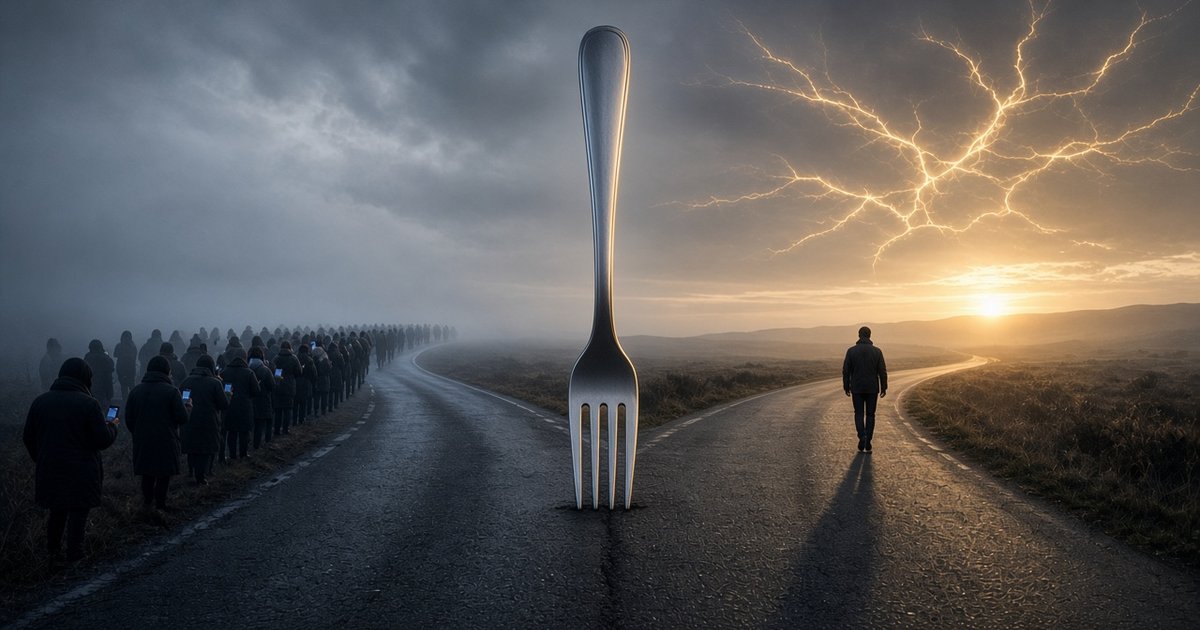
But I still feel a bit alone here. The fork in the road did its job: it gave us the chance to choose. And even though AI has the chance to change the lives of those who use it, now and in the future, I still see most people not taking it yet. They stay with their five video subscriptions and their social media feeds, waiting to see where this goes.
I don't think they will never come. Most of them will, just like touchscreens became normal. The problem is that waiting costs more this time. With the Surface, you could skip a few years, buy the device later and catch up in a weekend. The hardware was the advantage, and anyone could buy it. With AI, the advantage is not the hardware. It is the skill of using it, and that skill compounds.
Every month I use it, I get a bit better. I learn how to explain what I want, when to trust the answer and when to check it. I build workflows that I reuse, and then I build new ones on top of them. I develop a taste for what a good result looks like. None of this comes in the box. Someone who starts a year from now will get the same models I have, maybe better ones, but not the year of practice. And while they start, I am still moving, so the gap gets wider, not smaller.
The good news is that the skills needed may be smaller than ever. In the past, to take part in a revolution you sometimes had to be a toolmaker yourself. Today you mostly need curiosity and the habit of trying. But AI still gives better results to a better "operator". The same tool, in two different hands, gives two very different results.
The early adopters will see exponential growth, even one-person companies worth billions. Dario Amodei (Anthropic) predicted the first one-person $1B company around 2026.
And those who wait will probably keep scrolling, watching someone else's AI videos, and one day feel that luck was not on their side. They will talk, once again, about not having equal chances, and about the gap between them and the early adopters running billion-dollar companies. I understand that feeling, but this time the chance is right there, for almost everyone.
It is just history repeating itself, again and again. Even if it looks like we evolve, we never learn.
Image generated by Grok Bot.
